
It’s Time to Legalize Cannabis.
End Federal Cannabis Prohibition — Your Voice Matters Now
The Cannabis Legalization Act of 2027 finally fixes federal cannabis laws, protects CBD, shuts down dangerous hemp loopholes, and gives states full control to regulate cannabis like alcohol and tobacco.
Your senators need to hear from you.
Read the bill below, suggest updates. Using the “CONTACT US” Button
👉 Take action. Tell your Senators to support the Cannabis Legalization Act of 2026.
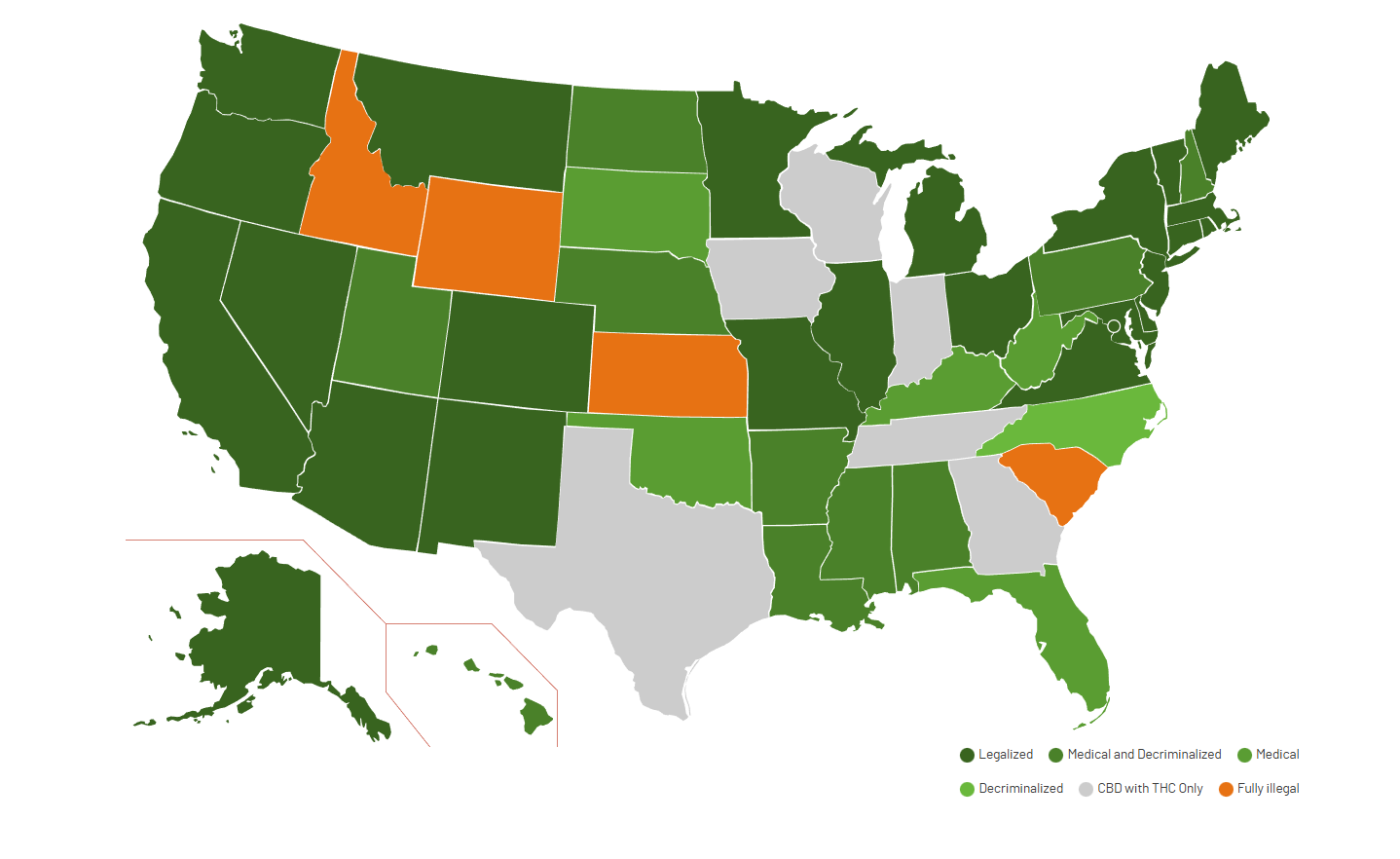
Current Legal State Map
THE CANNABIS FREEDOM, PARITY, AND HEMP MODERNIZATION ACT OF 2026
A Bill
To fully legalize cannabis at the federal level, remove cannabis from all schedules of the Controlled Substances Act, establish a unified national regulatory framework consistent with alcohol and tobacco, modernize Federal hemp policy by raising the hemp tetrahydrocannabinol tolerance to protect farmers, protect cannabidiol and other non-intoxicating hemp derivatives, restore Federal rights to cannabis consumers, expunge past non-violent convictions, support farmers and disadvantaged communities, advance hemp-based and economy-wide carbon-negative innovation, enable interstate commerce, and protect tribal sovereignty.
DISCUSSION DRAFT. Statutory cross-references are placeholders pending review by legislative counsel. Drafting notes for counsel appear in the appendix and are not part of the bill text.
Be it enacted by the Senate and House of Representatives of the United States of America in Congress assembled,
TITLE I: SHORT TITLE, FINDINGS, AND PURPOSE
Section 101. Short Title
This Act may be cited as the "Cannabis Freedom, Parity, and Hemp Modernization Act of 2026."
Section 102. Findings
Congress finds the following:
1. The federal prohibition of cannabis was founded on claims that were not supported by science, and cannabis has never produced mortality rates comparable to those associated with alcohol or tobacco, both of which are federally legal and regulated.
2. The rescheduling of cannabis to Schedule III is a step in the right direction but does not legalize cannabis, does not end criminal liability for consumers, and does not provide farmers or businesses with regulatory certainty. Full descheduling and legalization are required.
3. Cannabis prohibition created a nationwide unregulated intoxicant gray market that legalization, properly structured, will replace with a safe and taxed market.
4. Thirty-nine states have legalized medical or adult-use cannabis, and forty-seven states allow some legal form of cannabis or hemp derivative.
5. Industrial hemp is an agricultural commodity that requires a workable tetrahydrocannabinol tolerance. The current 0.3 percent total THC threshold is so low that a compliant crop can test "hot" due to weather, genetics, or testing variance through no fault of the farmer, forcing destruction of an entire harvest. Between 10 and 24 percent of hemp crops have been destroyed for marginally exceeding this limit.
6. A 1.0 percent total THC tolerance on a dry-weight basis allows farmers whose crops drift above 0.3 percent to bring their crop to market rather than destroy it. One percent is the threshold identified by Ernest Small, the scientist who proposed the original 0.3 percent line, as the practical point below which cannabis has no meaningful abuse potential, and it is the tolerance used by Switzerland, Thailand, and Australia and proposed in prior Federal legislation. Any product actually capable of producing an intoxicating effect is regulated as cannabis regardless of total THC concentration or source.
7. Cannabidiol (CBD) is widely used, non-intoxicating, and safe when derived from lawful hemp.
8. Hemp is a carbon-negative crop, and carbon captured through hemp cultivation and hemp-derived products should be recognized through the existing, crop-neutral federal carbon measurement framework rather than any commodity-specific program.
9. A clear national framework is necessary for product safety, interstate commerce, taxation, financial services, and the integrity of carbon markets.
Section 103. Purpose
The purpose of this Act is to fully legalize and regulate cannabis at the federal level, modernize hemp policy to protect farmers, protect public health and safety, generate tax revenue, stimulate United States agriculture and industry, repair the harms of prohibition, and respect the rights of states and tribes.
TITLE II: DEFINITIONS
Section 201. Definitions
In this Act:
(a) Hemp. The plant Cannabis sativa L. and any part of that plant, including the seeds, fiber, hurd, grain, derivatives, extracts, and non-intoxicating cannabinoids, acids, and salts, containing not more than 1.0 percent total THC on a dry-weight basis. The 1.0 percent threshold is the operative test for classification as hemp.
(b) Cannabis. The plant Cannabis sativa L., or any derivative, extract, concentrate, compound, or product that contains more than 1.0 percent total THC on a dry-weight basis, or that, irrespective of total THC concentration, has been synthesized, converted, or formulated so as to be capable of producing an intoxicating effect.
(c) Total THC. The aggregate concentration of delta-9 THC, THCA (calculated post-decarboxylation), delta-8 THC, delta-10 THC, HHC, THC-O, THC-P, THC-B, and all intoxicating analogs, esters, salts, and synthetic or semi-synthetic cannabinoids.
(d) Intoxicating Effect. Any measurable psychoactive, euphoric, depressant, stimulant, or psychotropic effect.
(e) Licensed Entity. Any individual or business licensed under this Act or under a state cannabis program.
(f) Cannabidiol (CBD); Safe Harbor.
1. CBD derived from lawful hemp is not cannabis and shall not be treated as an intoxicating substance.
2. Hemp-derived CBD products remain regulated as hemp, provided they contain not more than 1.0 percent total THC and are not intoxicating.
3. Non-intoxicating cannabinoids (including CBN, CBC, CBT, CBDa, and CBG) remain hemp unless intentionally converted into intoxicating cannabinoids.
4. Standard hemp extraction processes do not constitute cannabis manufacturing.
5. Notwithstanding section 201(ff) of the Federal Food, Drug, and Cosmetic Act (the drug-exclusion rule), the FDA may regulate hemp-derived CBD as a dietary ingredient, food additive, or consumer product, and may not classify hemp-derived CBD as a drug unless it is artificially synthesized or combined with intoxicating cannabinoids.
6. CBD products may freely participate in interstate commerce under hemp regulations.
TITLE III: DESCHEDULING AND FULL FEDERAL LEGALIZATION
Section 301. Removal from the Controlled Substances Act
(a) Cannabis, marihuana, and tetrahydrocannabinols are removed from all schedules of the Controlled Substances Act, including the Schedule III placement effective in 2026, and are deleted from 21 U.S.C. 812. (b) The Drug Enforcement Administration shall have no regulatory authority over cannabis or hemp, and the Attorney General's scheduling authority under 21 U.S.C. 811 shall not apply to cannabis or hemp.
Section 302. Conforming Repeals and Amendments
To give full effect to legalization, the following are repealed or amended insofar as they apply to cannabis or hemp:
1. 21 U.S.C. 841 and 844 (manufacture, distribution, and possession offenses).
2. 21 U.S.C. 811 and 821 through 824 (registration and scheduling authority).
3. 26 U.S.C. 280E is amended to no longer deny ordinary and necessary business expense deductions to lawful cannabis businesses.
4. The hemp definition at 7 U.S.C. 1639o is amended to conform to section 201(a) of this Act, superseding the 0.3 percent total THC threshold established by Public Law 119-37.
5. The Federal Food, Drug, and Cosmetic Act (21 U.S.C. 301 et seq.) is amended to reflect the CBD safe harbor in section 201(f).
6. The Bank Secrecy Act and 18 U.S.C. 1956 and 1957 are amended so that proceeds of lawful cannabis activity are not unlawful proceeds.
Section 303. Lawful Conduct
It is lawful under Federal law to cultivate, manufacture, distribute, transport, possess, or consume cannabis in accordance with this Act and applicable state and tribal law.
TITLE IV: REGULATORY STRUCTURE
Section 401. Agency Roles
(a) Alcohol and Tobacco Tax and Trade Bureau (TTB). Regulates licensing, taxation, import and export, and advertising.
(b) Food and Drug Administration (FDA). Oversees cannabis-infused foods, beverages, supplements, and therapeutic claims, and regulates synthetic and semi-synthetic cannabinoids as cannabis products if intoxicating.
(c) U.S. Department of Agriculture (USDA). Regulates cultivation, crop certification, and organic standards.
(d) Bureau of Alcohol, Tobacco, Firearms, and Explosives (ATF). Expands its enforcement scope to cover diversion, trafficking, and smuggling.
Section 402. Joint Enforcement
ATF, FDA, and USDA shall jointly enforce the penalties established under this Act.
TITLE V: CLOSING THE INTOXICANT LOOPHOLE
Section 501. Reclassification of Intoxicating Products
Any product capable of producing an intoxicating effect is classified as cannabis, regardless of origin or total THC concentration, and is subject to cannabis regulation under this Act.
Section 502. Licensing of Chemical Conversion
Any chemical conversion that produces an intoxicating cannabinoid requires a cannabis manufacturing license. Unlicensed intoxicating production or distribution is prohibited and subject to Federal enforcement.
Section 503. Synthetic Cannabinoid Regulation
All synthetic and semi-synthetic cannabinoids that are intoxicating shall be classified as cannabis and regulated under this Act. Non-intoxicating synthetic cannabinoids may be classified as hemp only if the FDA determines they are safe.
TITLE VI: STATE AND TRIBAL AUTHORITY
Section 601. State Regulatory Authority
(a) States with legal cannabis retain full control within their borders. (b) A state may maintain internal prohibition of cannabis sales and possession within its own borders. (c) A state may not blockade, seize, tariff, or otherwise obstruct the interstate transport of federally lawful cannabis or hemp shipments through or across its territory. (d) Federal law and Federal enforcement continue to apply within every state to unlicensed intoxicating products. Nothing in this Act compels a state to enact or administer any regulatory program.
Drafting note: subsection (d) is written to avoid an anti-commandeering problem under Printz v. United States and New York v. United States by relying on Federal enforcement rather than directing states to regulate. See appendix.
Section 602. State Classification
For purposes of Federal coordination only, states are described as:
- Tier I: Adult-use states.
- Tier II: Medical-only states.
- Tier III: CBD-only states.
- Tier IV: Prohibition states.
This classification is descriptive and does not impose regulatory duties on any state. No state may obstruct interstate commerce.
Section 603. Tribal Sovereignty
Tribes may regulate cannabis on tribal lands and participate in interstate commerce without state interference.
TITLE VII: COMMERCE, TAXATION, AND BANKING
Section 701. Interstate Commerce
Cannabis and hemp products may move lawfully across state lines. States may regulate or restrict retail sales within their borders but may not blockade, seize, tariff, or otherwise obstruct federally lawful shipments.
Section 702. Federal Taxation and Revenue Allocation
(a) A federal excise tax shall be imposed on cannabis products (products exceeding 1.0 percent total THC or otherwise intoxicating), modeled on the taxation of alcohol and tobacco. (b) Hemp products (not more than 1.0 percent total THC and non-intoxicating) are exempt from cannabis excise taxes. (c) Revenue shall be allocated as follows:
- 30 percent: Public health, prevention, and treatment.
- 30 percent: Education and infrastructure.
- 20 percent: Minority-owned, veteran-owned, and small business development.
- 20 percent: Hemp infrastructure, carbon-negative initiatives, and rural development.
Projected annual revenue: $10 to $20 billion.
Section 703. Banking, Financial Services, and Federal Rights
(a) Cannabis and hemp businesses shall have full access to federal banking, insurance, credit, and bankruptcy protections, with SAFER Banking protections integrated. (b) No person shall lose federal employment, housing, VA benefits, SNAP, or student aid on the basis of lawful cannabis activity.
TITLE VIII: PUBLIC HEALTH, SAFETY, AND JUSTICE
Section 801. Age Restrictions
(a) Cannabis products (exceeding 1.0 percent total THC or otherwise intoxicating) are restricted to individuals 21 years of age and older. (b) Hemp products (not more than 1.0 percent total THC and non-intoxicating) may be sold without a Federal age restriction, subject to state law, except that smokable or inhalable hemp flower is restricted to individuals 21 years of age and older.
Section 802. Impaired Driving Standards
The National Highway Traffic Safety Administration (NHTSA) shall establish national standards for cannabis-impaired driving.
Section 803. Labeling and Packaging Standards
Cannabis and hemp products shall include clear labeling of THC and CBD content, terpene profiles, safety warnings, and child-resistant packaging.
Section 804. Expungement of Convictions
All federal non-violent cannabis-related convictions shall be automatically expunged within 12 months of enactment.
Section 805. Medical Research and Access
The National Institutes of Health (NIH) shall prioritize cannabis-related research and establish national guidelines. Medical practitioners shall not be penalized under state or federal law for recommending cannabis.
Section 806. Veterans' Access
Veterans shall have protected access to cannabis therapies through the Department of Veterans Affairs without penalty.
Section 807. Foreign Ownership Restrictions
No cannabis or hemp business may be majority-owned or controlled by foreign entities.
TITLE IX: AGRICULTURE AND HEMP INDUSTRIALIZATION
Section 901. Industrial Hemp Modernization
Hemp containing not more than 1.0 percent total THC is fully legal as an agricultural commodity. The Federal Government shall provide research, development, and grants for fiber, hurd, biochar, graphene, composites, and construction materials.
Section 902. Farmer Transition Support Fund
The Hemp Transition Support Fund is established to assist farmers transitioning into hemp cultivation, with preference for small farms, veterans, and disadvantaged farmers.
Section 903. Crop Tolerance and "Hot" Crops
A hemp crop that tests above 0.3 percent but not more than 1.0 percent total THC remains lawful hemp and may be brought to market. No such crop shall be ordered destroyed solely for exceeding the prior 0.3 percent threshold.
TITLE X: CARBON RECOGNITION (CROP-NEUTRAL)
Section 1001. Hemp Eligibility Under Existing Federal Carbon Framework
Carbon captured and durably stored through hemp cultivation and hemp-derived products, including soil organic carbon, biochar, construction materials, and durable goods, shall be eligible for recognition under the Growing Climate Solutions Act and any successor crop-neutral Federal greenhouse gas measurement, reporting, and verification program administered by the USDA. Nothing in this Act shall create a commodity-specific carbon office, registry, or program, or grant preferential recognition to any individual registry or verification body.
Drafting note: This title is deliberately crop-neutral and defers to the existing, technology-neutral Growing Climate Solutions Act framework, removing any appearance of a single-industry or single-company carve-out.
TITLE XI: IMPLEMENTATION AND GENERAL PROVISIONS
Section 1101. Implementation Timeline
- Immediate: Full descheduling and legalization take effect.
- 6 months: Interstate commerce regulations issued.
- 12 months: Full federal framework in place; agencies issue interim rules; expungement complete.
- 18 months: Banking and tax provisions active.
- 24 months: National integration complete.
Section 1102. Severability
If any provision of this Act, or its application to any person or circumstance, is held invalid, the remainder of the Act and its application shall not be affected.
APPENDIX: DRAFTING NOTES FOR LEGISLATIVE COUNSEL (NOT PART OF THE BILL)
The items below should be resolved by legislative counsel before introduction. They are drafting notes only and are not part of the enacted text.
1. 1.0 percent total THC threshold. Set at 1.0 percent total THC, the strongest evidence-backed tolerance: it reflects Ernest Small's own reconsideration of the original 0.3 percent line, and matches the tolerance used by Switzerland, Thailand, and Australia and proposed in the HEMP Act (S. 2112). It supersedes the 0.3 percent total THC standard in Public Law 119-37. Counsel should expect this to be a contested provision, because 1.0 percent triples the current Federal limit; the farmer "hot crop" findings in section 102(5)-(6) carry the argument.
2. Conforming amendments (Title III, Section 302). The specific U.S. Code citations are placeholders. Counsel must verify and expand the full list, including IRC 280E repeal mechanics and FDCA section 201(ff) drug-exclusion language.
3. Anti-commandeering (Title VI). Sections 601 and 602 rely on Federal enforcement rather than directing states, per Printz and New York v. United States. Counsel should confirm.
4. Excise tax structure (Section 702). Modeled on alcohol and tobacco but not yet specified by rate or tax base; requires Joint Committee on Taxation scoring.
5. Penalties. The Act references Federal enforcement and penalties but does not yet specify the penalty schedule; counsel must supply it.
6. Enacting clause and bill form. Present, but final section numbering and cross-references must follow Senate legislative drafting conventions.
End of draft.